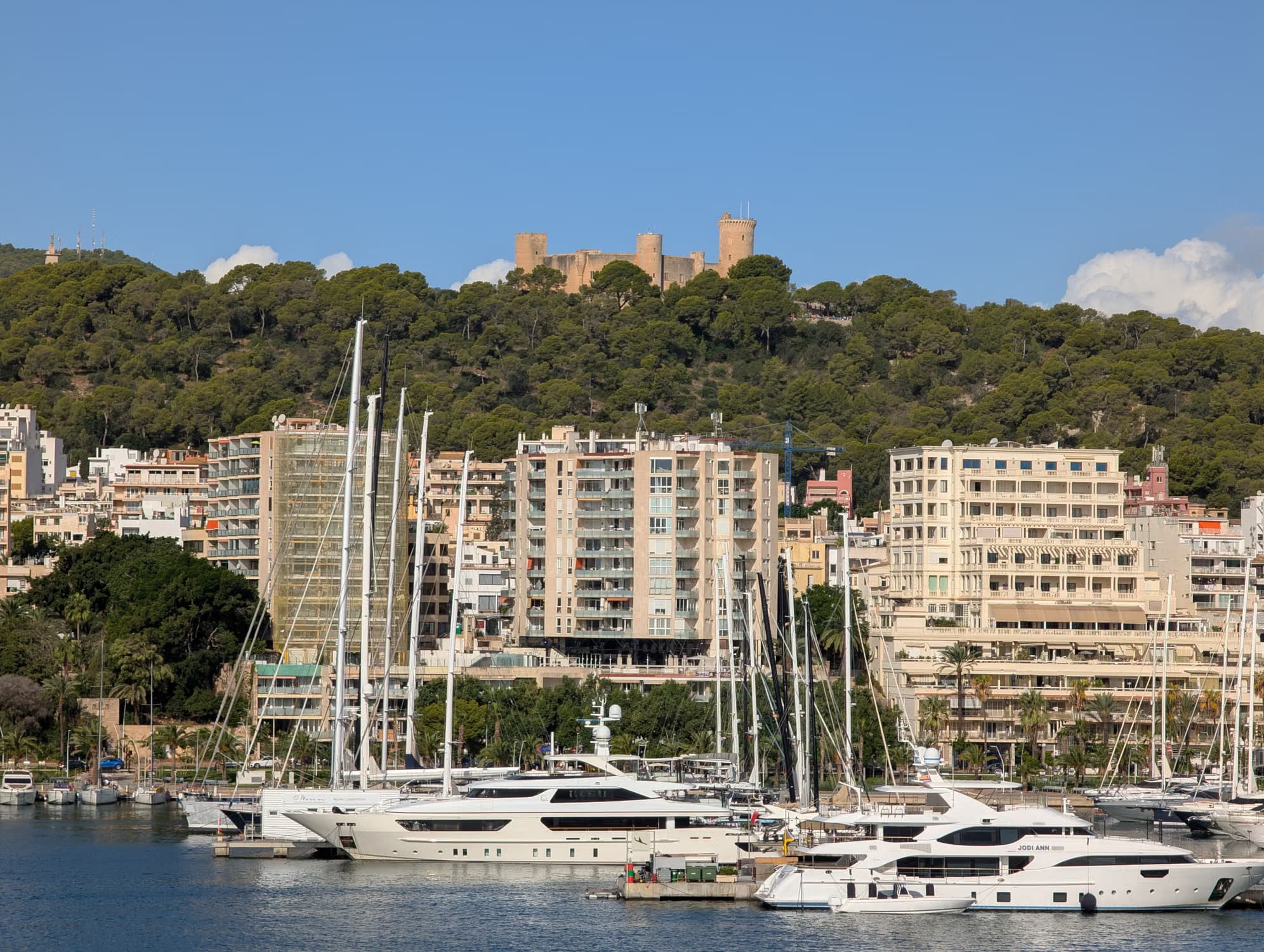
Treat the berth as part of the ownership plan
A marina is more than a parking place. Access, shelter, technical support, airport transfer time and the surrounding town all affect how often and how easily the yacht is used.
Confirm the yacht’s true dimensions and operational requirements before enquiring. Availability, contract terms and accepted dimensions vary by marina and season.
Palma for year-round access and technical depth
Palma places owners close to established yards, engineers, suppliers, crew services and the airport. It is often the practical choice for yachts that need frequent technical access or owners arriving for short visits.
The city setting is active throughout the year, although the right berth depends on yacht size and the atmosphere an owner prefers.
South-west marinas for a resort-style base
Port Adriano and Puerto Portals combine protected berthing with restaurants, services and quick access to the south-west coast. They can suit owners who want the marina to form part of the leisure experience.
Port d’Andratx offers a different character, with a working harbour and immediate access to the Tramuntana coastline.
Look beyond the home berth
Dry storage, winter works, fuel access, guest parking and tender arrangements may matter as much as the summer berth. Ask how the yacht will be supported when you are not on the island.
A local comparison should be made with current availability and written marina terms rather than assumptions based on reputation alone.
Match the marina to your ownership pattern
Start with a calendar, not a marina brochure. An owner flying in for frequent long weekends values airport access, reliable late-arrival procedures and technicians who can prepare the yacht before landing. A family spending several continuous summer weeks may place more weight on restaurants, beaches, guest parking and a calm social setting. A professionally crewed yacht needs storage, deliveries, waste handling, shore power and year-round technical access. The same marina will not rank first for all three patterns.
Map the first and last hour of every trip. Include the airport transfer, loading provisions, parking, access-control process, fuel stop and the time required to clear the harbour. Then consider the return: pump-out or waste, wash-down, laundry, defects, key handover and the person checking the yacht after the owner leaves. Small frictions repeated over a season often matter more than a modest difference in straight-line cruising distance.
Use measured dimensions, not the model name
A berth enquiry should state overall length and maximum beam as the yacht will actually arrive, including fixed platforms, pulpit, anchors, fenders and other projections as required by the marina. Add draft, displacement, shore-power requirement and whether the passerelle, tender or manoeuvring characteristics create constraints. Published model dimensions can differ from the configuration afloat, and marinas sell physical spaces with defined limits rather than generic places for a model range.
Ask how the berth behaves, not only whether the yacht fits. Confirm depth and any restrictions at the berth and approach, prevailing wind exposure, mooring arrangement, distance to power and water, electrical capacity, mobile and Wi-Fi coverage, fuelling method and access for service vehicles. A technically valid berth can still be inconvenient if the gangway geometry is poor, the power supply is inadequate or manoeuvring leaves little margin in the winds most common at your arrival time.
Understand Palma’s practical advantage
Palma is compelling when the ownership plan depends on technical depth. STP Shipyard Palma describes a 130,000-square-metre refit area, travel lifts up to 1,000 tonnes and capacity for yachts up to 120 metres. Those figures are not a promise that every contractor or slot will be available, but they illustrate why Palma supports complex refit, warranty and engineering programmes. A city base also places crew services, suppliers and accommodation within a concentrated marine ecosystem.
Access reinforces that advantage. Aena states that Palma de Mallorca Airport is eight kilometres from the city and handled 33.8 million passengers in 2025, with predominantly international traffic and many mainland connections. Owners should still test real transfer times at their usual travel hour and check where guests can be collected. Palma’s trade-off is a more urban, working-harbour environment; some owners prefer that energy, while others want the yacht to open directly onto a resort or smaller coastal town.
Compare the south-west options on verified facts
Puerto Portals currently publishes berth categories from eight to 60 metres, with water, power, Wi-Fi, fuelling and 24-hour mariner and security services, and states that it lies 10 kilometres from Palma and 16 kilometres from the airport. Its restaurants, retail and event programme make the shore-side experience a central part of the proposition. Availability and the commercial terms for a particular size remain separate questions and should be confirmed directly.
Port Adriano publishes 487 moorings from six to 80 metres, plus a 10,000-square-metre shipyard, a high-capacity travel lift and seasonal dry-stack service. That combination can suit owners who want a designed marina environment with substantial on-site technical support and superyacht capability. Port d’Andratx, by contrast, combines a working harbour and town with immediate access to the south-west and Tramuntana coast. Its public and concession-operated spaces follow their own allocation and reservation processes rather than the model of one uniform private marina.
Read the berth agreement as an operating document
Request the full written terms before paying. Check dates, renewal rights, cancellation, security deposit, VAT, utilities, liveaboard or guest rules, subcontractor access, insurance limits, documentation requirements and what happens if the yacht’s measured dimensions differ. Clarify whether the price is for a named berth or a category from which the marina may move the yacht, and whether absence must be reported or allows the berth to be re-let.
Build a total annual cost rather than comparing headline rent. Add metered electricity and water, parking, waste, diver checks, storm lines, tender storage, haul-outs, winterisation, security or guardianage and the cost of moving the yacht for maintenance. Public PortsIB transit spaces use an online reservation framework and size limits; seasonal transit procedures can have defined application windows. A home berth, visitor berth and summer cruising reservations should therefore be planned as three connected but different problems.
Score a shortlist before committing
Reduce the choice to two or three marinas and score each against weighted criteria: fit and manoeuvring, contract security, travel access, technical support, cruising access, shore-side life, winter operations and total cost. Weighting forces an honest answer. If spontaneous weekend use is the objective, access and preparation may outweigh ambience; if the yacht is a summer home, the surrounding place may deserve more weight.
Visit at the times that expose reality: a busy summer afternoon, after normal office hours and, if year-round ownership matters, in winter. Walk the route from car to berth, inspect access and utilities, speak with captaincy about your exact yacht and obtain every material assurance in writing. A marina choice is reversible, but moving can be disruptive and the best alternatives may not be available when a contract problem appears. A disciplined comparison before purchase is considerably cheaper than solving a berth mismatch afterwards.
Official sources and further reading
The practical guidance above was checked against the following official and first-party sources. Rules, availability and operating conditions can change, so consult the linked source again before acting.
- 01 · Puerto PortalsBerths and current berth categories — Open source ↗
- 02 · Port AdrianoMoorings and technical services — Open source ↗
- 03 · STP Shipyard PalmaPalma refit and repair facilities — Open source ↗
- 04 · Ports de les Illes BalearsMallorca harbours and online transient reservations — Open source ↗
- 05 · Ports de les Illes BalearsSeasonal transient berth procedure — Open source ↗
- 06 · AenaPalma de Mallorca Airport overview — Open source ↗